
VoIP & Business Phone Systems in Colorado Springs
When Your Phone System Holds Your Business Back, You Feel It Every Day
An outdated business phone system doesn’t just cost you money—it limits your flexibility, frustrates your team, and creates friction every time someone tries to reach you or a client tries to reach them.
Outdated Systems Create Costly Monthly Bills With No Flexibility
Traditional PBX phone systems and legacy telephone services come with high monthly per-line costs, expensive long-distance charges, and steep fees every time you need to add a line, move an extension, or make system changes. You’re paying premium prices for inflexible infrastructure that can’t adapt to how modern businesses actually work—and the bills keep coming whether your phones are ringing or sitting idle. Every month is another reminder that you’re overpaying for a system that’s falling further behind.
Poor Call Quality Damages Client Relationships
Dropped calls, crackling audio, echo on the line, and missed transfers make your business sound unprofessional to every client, prospect, and partner who calls. When someone calls your company and can’t hear clearly, has to repeat themselves, or gets disconnected mid-conversation, that frustration reflects directly on your brand. You can’t control what clients think about call quality—but you can control whether your phone system causes those problems in the first place.
Legacy Systems Can't Support Remote and Hybrid Teams
When your phone system is hardwired to your office, remote employees become unreachable through business lines, mobile numbers replace professional extensions, and unified communications become impossible. The result is a fragmented communication experience where clients get inconsistent experiences, remote workers feel disconnected, and nobody has visibility into missed calls or voicemails. Your phone system was built for the way business worked twenty years ago—not for the distributed, flexible teams most businesses manage today.
Modern Business Communications That Work the Way You Do
Imagine a phone system that costs significantly less than what you’re paying now, delivers professional call quality on every call, and gives every team member the same business communications capability whether they’re at their desk, working from home, or on the road.
Significantly Lower Monthly Phone Bills From Day One
Most businesses switching from traditional phone systems to VoIP see immediate reductions in monthly communication costs—often 40-60% less than legacy telephone service. With VoIP, you pay for your internet connection and a predictable monthly service fee rather than expensive per-line charges and long-distance fees. Adding extensions costs a fraction of traditional system expansion. The savings are real, measurable, and start appearing in your first bill after cutover.
Crystal-Clear Call Quality That Reflects Your Professionalism
Modern VoIP systems running on properly configured networks deliver HD call quality that sounds better than traditional phone lines—clear voice audio, no echo, no static, and reliable connections that represent your business professionally on every call. When your infrastructure is set up correctly by experienced technicians, call quality becomes a non-issue rather than a daily frustration. Your clients hear a professional business, every time they call.
Full Communications Flexibility for Office, Remote, and Mobile Teams
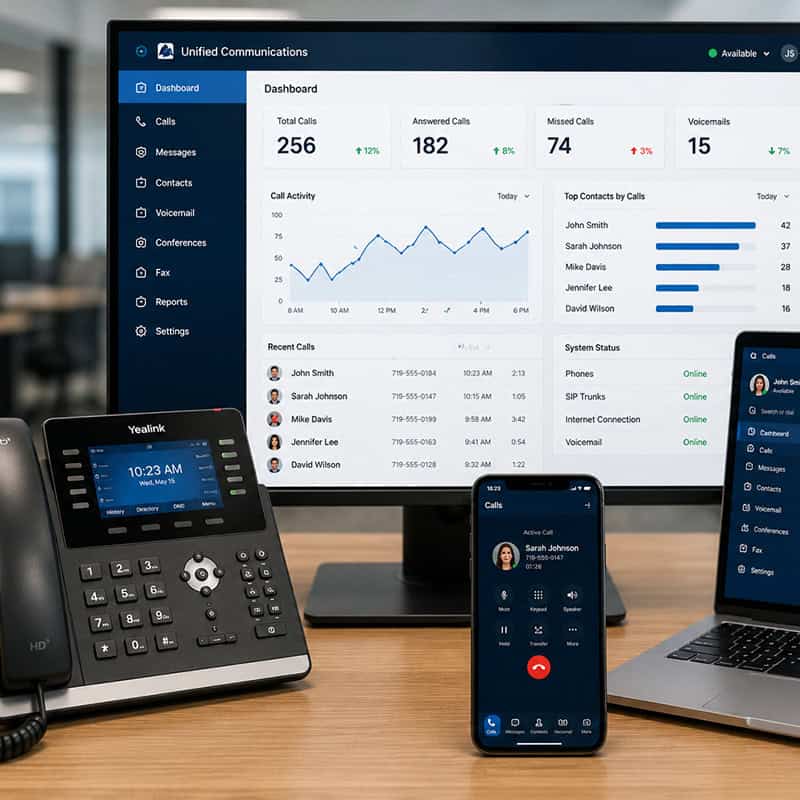
Every employee gets the same business communications capability regardless of where they work. Desk phones in the office, softphone apps on laptops and smartphones, professional voicemail-to-email, extension dialing between locations, and unified messaging across devices. Remote employees answer business calls on their cell phones while showing your business number. Office staff transfer calls seamlessly to remote colleagues. Everyone stays connected under one professional communications system that scales as your team grows.
Upgrading Your Business Phone System Is Simpler Than You Think
We’ve made the transition process straightforward and low-risk—so you can move to modern VoIP communications with confidence, knowing exactly what to expect at every stage.
Step 1: Free Communications Assessment and Cost Analysis
We’ll review your current phone system, understand your team’s communication needs, assess your network infrastructure for VoIP readiness, and build an honest cost comparison showing what you’re paying now versus what you’d pay with a properly designed VoIP system. No pressure, no obligation—just clear information that helps you make the right decision for your business.
Step 2: Custom VoIP System Design and Migration Plan
Based on your assessment, we’ll design a VoIP system tailored to your business—selecting the right hosted platform, configuring your call flow, planning your number porting timeline, and ensuring your network infrastructure is ready to deliver the call quality your business needs. You’ll receive a detailed proposal with transparent pricing and a complete migration plan before any work begins.
Step 3: Professional Installation With Zero-Downtime Cutover
Our technicians will install and configure your VoIP system, port your existing phone numbers, set up every extension and feature, and train your team on the new system—all before your old system is disconnected. The cutover happens at a scheduled time of your choosing, your phones stay live throughout, and your team arrives to a fully functioning new system with zero disruption to your business operations.
Colorado Springs' Business Phone System Specialists
We understand why you’ve been putting off this upgrade. Phone systems feel complicated to change, and the fear of downtime during a cutover—of your business being unreachable while the transition happens—makes it easy to keep paying too much for a system that’s frustrating everyone. You need a partner who makes the transition seamless, handles the technical complexity, and ensures your phones keep working throughout the entire process.
Colorado Springs Cable Connections specializes in VoIP and business phone system installation for commercial clients throughout El Paso County. Our communications technicians design, install, and configure hosted VoIP systems, SIP trunking, unified communications platforms, and complete phone system migrations—handling everything from network readiness assessment to number porting to staff training. We’re locally owned, Colorado Springs based, and committed to delivering modern business communications that reduce your costs and improve your team’s ability to connect with clients.
Every VoIP installation includes network readiness assessment, number porting management, complete system configuration, and user training before cutover.
Why Colorado Springs Businesses Trust Us for Their Phone Systems
When you need VoIP phone systems Colorado Springs businesses can rely on, you need more than a vendor who ships you IP phones and points you to an online setup guide. You need a local partner who manages the entire transition—from network assessment and system design to number porting, installation, configuration, and training—so your business communications upgrade actually delivers the reliability, cost savings, and flexibility you’re investing in. At Colorado Springs Cable Connections, we handle every detail of your phone system migration so you don’t have to.
We work exclusively in Colorado Springs and El Paso County, which means when you have a question after installation, a feature you can’t figure out, or an issue that needs immediate attention, we’re a local phone call away—not a support ticket to a national provider’s remote help desk. Our local presence means faster response times and a long-term relationship with a partner who knows your system and your business.
Our VoIP and business phone system services cover everything your communications infrastructure needs: hosted VoIP systems with enterprise-grade features at small business pricing, SIP trunking for businesses with existing on-premises PBX equipment, complete PBX replacement for businesses ready to fully modernize, number porting to transfer all existing business phone numbers to the new system, auto-attendant and IVR configuration for professional call routing, voicemail-to-email and unified messaging setup, softphone applications for remote and mobile workers, call recording for compliance and quality monitoring, conference calling and video integration, and network infrastructure optimization to ensure VoIP call quality meets professional standards.
Whether you’re a small business ready to cut the cord on expensive traditional phone service, a growing company that needs flexible communications to support a distributed team, or an established organization with a legacy system that’s finally reached end of life, we approach every phone system project with the same commitment to zero-downtime transitions, complete training, and ongoing support. Because when your business communications work reliably and professionally, your team focuses on serving clients instead of managing phone problems—and that’s exactly how it should be.
Frequently Asked Questions
How much can we actually save by switching to VoIP?
Savings vary based on your current system, number of lines, and call volume, but most businesses switching from traditional phone service to VoIP see 40-60% reductions in monthly communication costs. The savings come from lower per-line costs, eliminated long-distance charges, reduced maintenance fees, and significantly cheaper expansion when adding new employees. During your free assessment, we’ll build a specific cost comparison using your actual current bills so you can see the real numbers before making any decisions.
Will our existing phone numbers transfer to the new system?
Yes, in virtually all cases your existing business phone numbers transfer to the new VoIP system through a process called number porting. We manage the entire porting process—submitting the transfer requests to your current carrier, coordinating the porting timeline, and ensuring your numbers are active on the new system before your old service is disconnected. The porting process typically takes 2-4 weeks and we schedule everything so your numbers are never simultaneously inactive during the transition.
What happens to our phones during an internet outage?
This is the most common concern about VoIP, and it’s a legitimate one worth planning for. We address it in several ways: business-grade internet with failover connectivity (cellular backup), call forwarding rules that automatically route calls to mobile phones during outages, and where appropriate, a small number of traditional lines kept as emergency backup. The right solution depends on your business’s call volume and risk tolerance. During your assessment, we’ll discuss your specific reliability requirements and design appropriate redundancy into your system.
Can remote employees use the business phone system from home?
Absolutely—this is one of VoIP’s most valuable capabilities. Remote employees install a softphone application on their computer or smartphone and get full business phone functionality: calls appear from your business number, they can transfer calls to colleagues, access voicemail, join conference calls, and use all system features exactly like an in-office employee. Clients calling your business number can be seamlessly transferred to remote team members without knowing or caring where that person is physically located.
How long does the transition from our old system take?
A typical small to mid-size business phone system transition takes 2-4 weeks from signed agreement to cutover. The timeline includes network assessment and any necessary infrastructure preparation, system configuration and feature setup, number porting coordination with your current carrier, equipment delivery and installation, user training, and a parallel testing period before cutover. We schedule the final cutover at a low-traffic time—typically evenings or weekends—and stay on-site until your team is fully operational on the new system.
What Colorado Springs Clients Say About Our VoIP & Business Phone Systems Service


Every Month You Wait Is Another Month of Overpaying
Every month you stay on your legacy phone system is another month of overpaying for outdated technology that limits your team’s flexibility. Let’s assess your current system, show you exactly what you’d save with VoIP, and build a migration plan that makes the transition seamless.